
How to Choose Paint Colors for an Open Floor Plan is one of the most common design questions homeowners face. Open-concept homes feel spacious and inviting, but because the kitchen, dining room, living room, foyer, and other spaces often flow directly into one another, choosing paint colors can feel more complicated than decorating separate rooms.
The goal is not to make every area exactly the same. A well-designed open floor plan should feel connected while still giving each space its own identity. The best way to accomplish that is to build a coordinated color palette using one dominant Benjamin Moore paint color, a few supporting colors, a consistent trim color, and carefully placed accents.
At Kucker Haney Paint, you can explore Benjamin Moore paint colors, samples, wallpaper, and painting supplies to create a palette that works throughout your open-concept home.
Where Should You Start When Choosing Colors for an Open Floor Plan?
Start with the most visually important room in the space. This might be the kitchen, the living room, or the area that contains a permanent feature you already love, such as a fireplace, large stone wall, cabinetry, or distinctive flooring.
Look carefully at the colors already in the space, including:
- Hardwood flooring
- Kitchen cabinets
- Countertops
- Backsplash
- Fireplace stone or brick
- Upholstery
- Rugs
- Window treatments
- Large pieces of furniture
These fixed finishes should help guide your paint palette. If your flooring and cabinetry have warm undertones, a warm neutral will usually create better flow. If the home has cooler finishes, a cooler neutral or soft blue-gray may feel more natural.
Lighting also matters. The same paint color can look very different in a bright kitchen than it does in a living room farther from the windows.
Why Does an Open Floor Plan Need a Dominant Paint Color?
A dominant paint color creates continuity. In an open floor plan, your eye often sees several areas at the same time, so using one main color across the largest wall surfaces helps the entire home feel intentional.
A neutral is often the easiest starting point because it provides a flexible foundation for furniture, artwork, rugs, and accessories.
Some Benjamin Moore colors that work beautifully as dominant colors include:
Edgecomb Gray HC-173
Edgecomb Gray is a soft, warm greige that works especially well in open spaces with warm wood floors, cream furnishings, and natural textures.
Ballet White OC-9
Ballet White is a warm off-white that provides brightness without feeling stark. It is a great choice for open-concept homes that need a soft backdrop.
Quiet Moments 1563
For homeowners who want more color, Quiet Moments is a soft blue-green-gray that can act almost like a neutral. It works especially well in airy homes with natural light.
Choose one of these as your main wall color, then build the rest of the palette around it rather than introducing too many competing shades.
How Many Paint Colors Should You Use in an Open Floor Plan?
You do not need a different paint color for every area. Too many unrelated colors can make an open-concept home feel fragmented.
A designer-friendly approach is to create a small palette that includes:
- One dominant wall color
- One or two supporting colors
- One consistent trim color
- One stronger accent color
The key is repetition. If you use a blue-green on the kitchen island, repeat that color somewhere else through artwork, pillows, accessories, or another small painted feature.
How Do You Create Separation Between Rooms Without Walls?
An open floor plan does not mean every wall has to be painted the same color.
Use architectural stopping points to introduce a secondary color. Good transition points include:
- Corners
- Columns
- Doorways
- Ceiling changes
- Built-ins
- Fireplace walls
- Kitchen islands
- Cabinetry
- Wainscoting
For example, you might use Edgecomb Gray HC-173 throughout the main walls and introduce Hale Navy HC-154 on the kitchen island or built-ins.
That creates visual separation without making the spaces feel disconnected.
Furniture and decorating also help define zones. Area rugs, lighting fixtures, furniture placement, and different textures can distinguish a dining space from a living space while the paint color remains consistent.
What Benjamin Moore Color Palettes Work Well in an Open Floor Plan?
Instead of choosing each room separately, build one coordinated palette and let the colors repeat throughout the space.
Warm and Natural
Walls: Edgecomb Gray HC-173
Trim: White Dove OC-17
Supporting Color: Saybrook Sage HC-114
Accent: Hale Navy HC-154
This palette works well with oak floors, warm wood cabinetry, linen furniture, and natural textures.
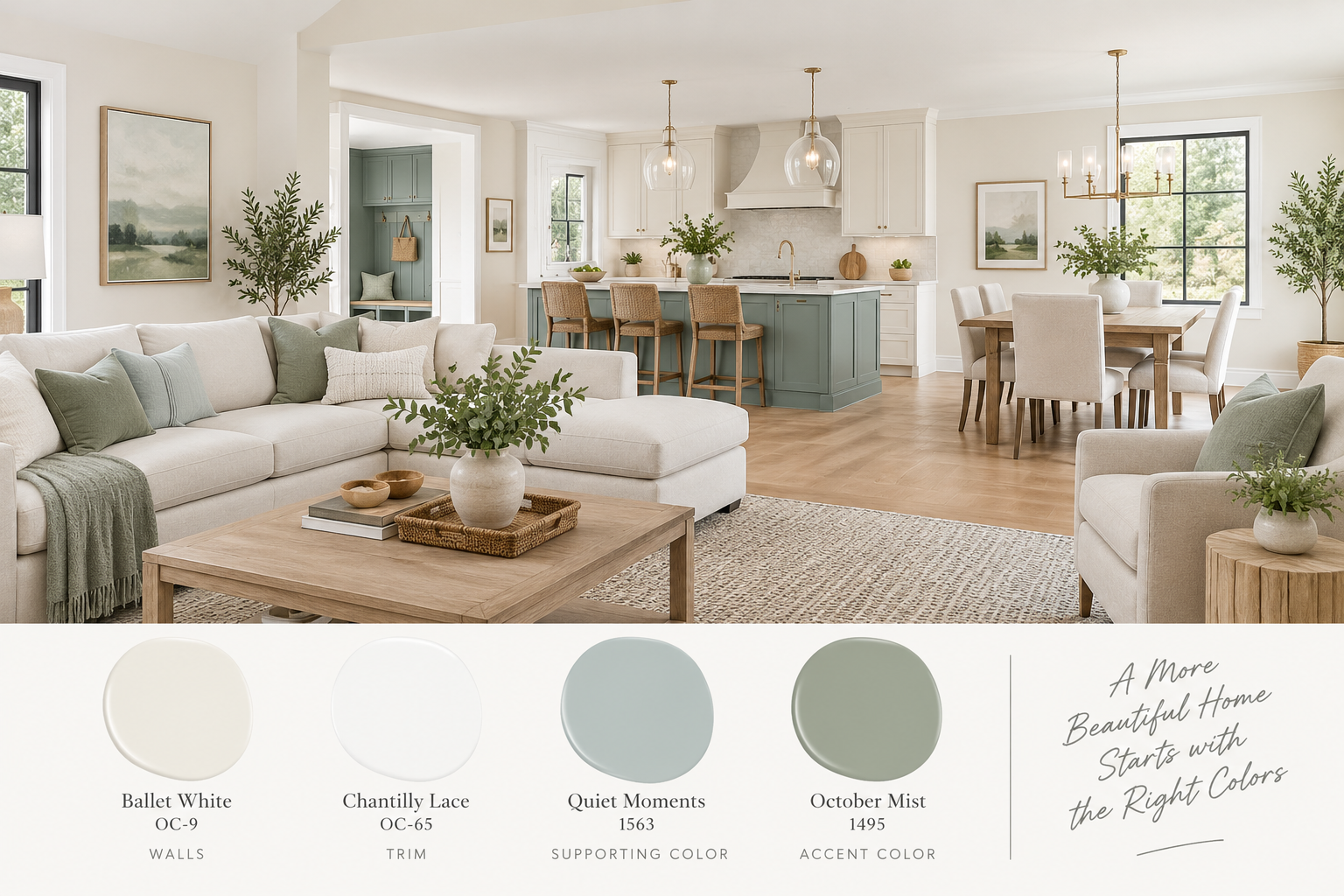
Light and Airy
Walls: Ballet White OC-9
Trim: Chantilly Lace OC-65
Supporting Color: Quiet Moments 1563
Accent: October Mist 1495
This combination feels soft, fresh, and relaxed.
Soft Contemporary
Walls: Steam AF-15
Trim: White Heron OC-57
Supporting Color: Paris Rain 1501
Accent: Iced Marble 1578
This palette works well in homes with cleaner lines, pale woods, and understated furnishings.
Should the Kitchen Be a Different Color From the Living Room?
It can be, but the colors need to relate.
If your kitchen and living room share one large wall, keeping that wall the same color often creates the cleanest result. You can then give the kitchen its own personality through cabinetry, an island, backsplash, lighting, and accessories.
For example, use Ballet White OC-9 on the main walls, then introduce Hale Navy HC-154 on the island. Repeat navy in the living room through pillows, artwork, or a chair.
This creates a clear relationship between the spaces without painting every area differently.
How Can You Use Accent Colors in an Open Floor Plan?
Accent colors are especially useful in open spaces because they create focal points.
Good places for a stronger Benjamin Moore color include:
- Kitchen islands
- Built-in bookcases
- Fireplace walls
- Interior doors
- Bar areas
- Mudroom cabinetry
- Dining room walls
- Powder room entrances
Some strong accent colors include:
Hale Navy HC-154 for a classic deep navy
Kendall Charcoal HC-166 for a rich charcoal
Salamander 2050-10 for a deep green
Shadow 2117-30 for a dramatic jewel-toned focal point
Use these shades selectively so they add definition without competing with the overall flow.
What Trim Color Should You Use Throughout an Open Floor Plan?
Using one trim color throughout the connected spaces is one of the easiest ways to create consistency.
Popular Benjamin Moore trim colors include:
- White Dove OC-17
- Chantilly Lace OC-65
- White Heron OC-57
- Simply White OC-117
- Swiss Coffee OC-45
Choose your trim color based on the undertone of your wall color. Warm greige walls usually look best with a softer white, while cooler blue-gray walls may work beautifully with a cleaner, brighter white.
Can You Use Dark Colors in an Open Floor Plan?
Absolutely. Dark colors can add depth to a large open space when they are used strategically. Instead of painting every wall dark, use a deeper shade to anchor a particular feature.
Try: 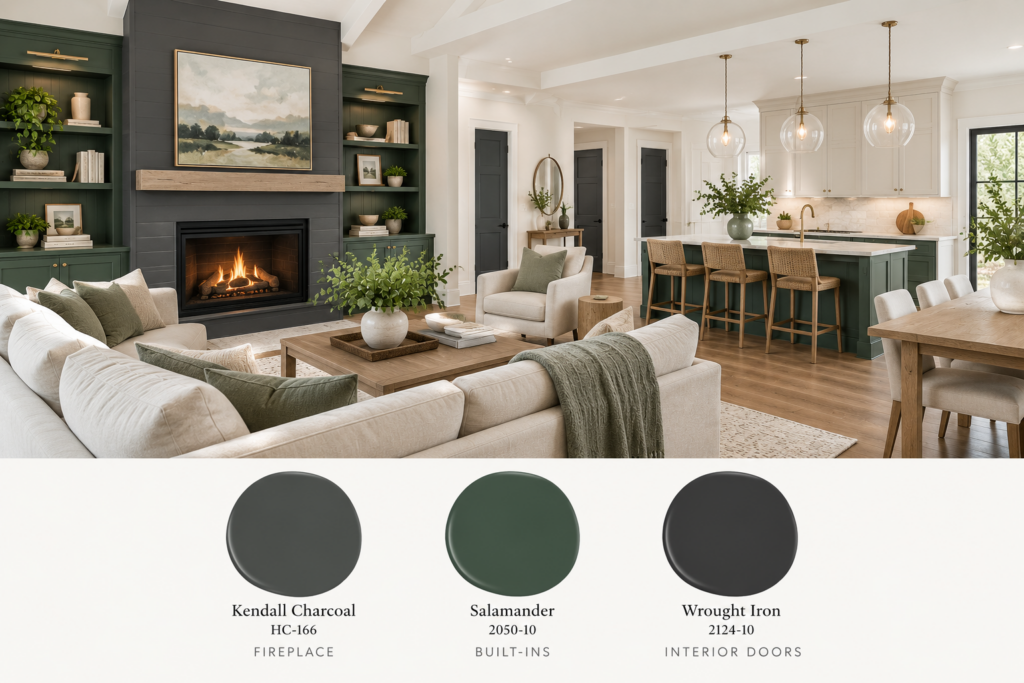
- Kendall Charcoal HC-166 on a fireplace
- Salamander 2050-10 on built-ins
- Wrought Iron 2124-10 on interior doors
Dark paint also works well in a dining area when you want that space to feel more intimate than the adjoining kitchen or living room.
The surrounding lighter walls keep the overall floor plan open while the dark color gives the room definition.
How Can Furniture and Accessories Help Connect the Color Palette?
Paint is only one part of an open floor plan.
To make the entire space feel connected, repeat colors and materials throughout the home.
If you use a deep blue accent in the kitchen, bring that same family into the living room through pillows, artwork, or accessories. If you introduce sage green near the dining area, repeat it with plants, fabrics, or decor nearby.
Repeat materials as well:
- Warm wood
- Black metal
- Brass
- Woven textures
- Linen
- Natural stone
- Glass
These repeated elements help each area feel like part of one larger design.
Can Wallpaper Work in an Open Floor Plan?
Wallpaper can be an excellent way to define one section of an open space without introducing another full wall color.
Consider wallpaper:
- Behind a dining room buffet
- In a built-in niche
- On a fireplace wall
- Inside bookshelves
- In a small bar area
- Along a short accent wall
Choose a wallpaper pattern that pulls colors from the surrounding Benjamin Moore palette.
For example, a botanical wallpaper with sage, cream, and beige could pair beautifully with warm greige walls and a soft white trim. This creates interest without adding another competing paint color.
Why Should You Test Paint Colors in Every Part of the Open Space?
Open floor plans often have dramatically different lighting conditions from one end of the space to the other.
A paint color near large windows may appear much lighter than the same color on a wall near the center of the home.
Before committing, test your Benjamin Moore colors in several locations.
Look at them:
- In morning light
- In afternoon light
- At night
- Under kitchen lighting
- Near your flooring
- Next to cabinetry
- Beside furniture
Testing several areas helps you see whether the undertones stay consistent throughout the entire floor plan.
Visit Kucker Haney Paint for Open Floor Plan Color Inspiration
Choosing paint colors for an open floor plan becomes much easier when you start with a coordinated palette instead of selecting each room separately.
Begin with one dominant Benjamin Moore color, add one or two supporting shades, choose a consistent trim color, and use stronger colors strategically to define individual areas.
Visit Kucker Haney Paint in Princeton, East Windsor, or Hamilton to explore Benjamin Moore paint colors, pick up samples, browse wallpaper, and get help creating a color palette that flows beautifully throughout your home.
Whether your style is warm and traditional, light and contemporary, coastal, farmhouse, or modern, the right Benjamin Moore colors can help your open floor plan feel connected, comfortable, and thoughtfully designed.